
Surgical instruments play an important role in medical procedures. If you’re a medical student, a healthcare professional, or someone new to the surgical field, learning their names, appearances, and functions is one of the first steps toward understanding how operations work. Each instrument has a specific purpose, such as cutting, holding, clamping, or suturing tissue.
Knowing these instruments helps you understand surgical setups, proper handling, and sterile practices in hospitals and clinics. In this guide, you’ll find 100 common surgical instruments with their names, pictures, and uses. We have divided them into different categories to make them easier to identify and understand, along with their roles in different types of surgery.
If you’re just starting, our blog post on 54 basic surgical instruments is a good place to begin.
If you prefer studying offline, you can download the PDF available at the end of this article. It includes surgical instrument names, pictures, and uses, making it easier to review the information whenever you need.
Surgical Scissors
Surgical scissors are commonly used instruments in operating rooms for cutting tissue, sutures, dressings, and other purposes. Different types are designed for specific tasks, and the right choice depends on what needs to be cut and the level of precision required. Blade shape, tip design, and length all affect precision and safety.
They are usually made from stainless steel, and some versions add tungsten carbide inserts or a ceramic coating for longer-lasting sharpness. Here are the common types of surgical scissors, their features, and how they are used.
1. Lister Bandage Scissors
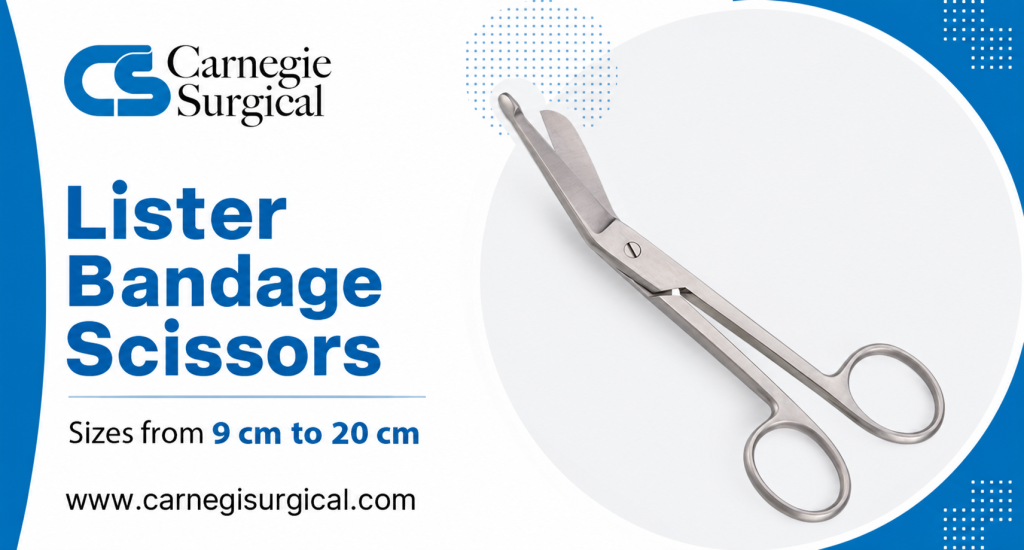
Lister bandage scissors are stainless steel instruments made for removing bandages, dressings, and medical tape quickly and safely. The blades are angled and the tips are blunt, so you can cut close to the skin with little risk of injury. They are available in 9 cm, 11.5 cm, 14 cm, 18 cm, and 20 cm lengths, plus a 20 cm version with a large ring, so you can pick the size that fits your setup.
Applications:
- Removing bandages and wound dressings in hospitals and clinics
- Emergency rooms, ambulances, and first aid kits
- Helping caregivers with wound care and dressing changes at home
2. Mayo Dissecting Scissors
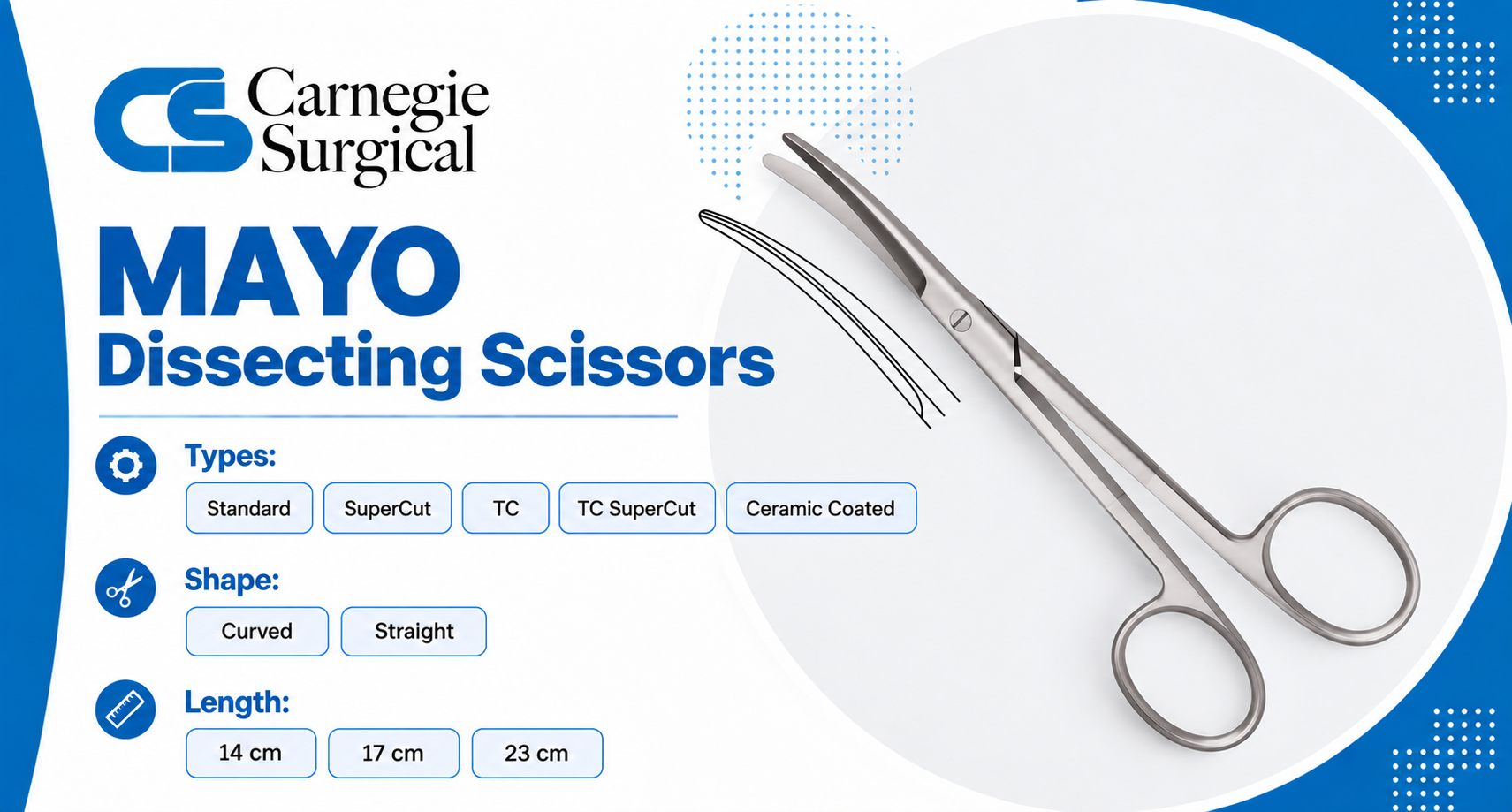
Mayo dissecting scissors are precision scissors used for fine dissection and cutting of tissue, including delicate work in neurosurgical procedures. In the SuperCut type, one blade is razor sharp and the other is micro-serrated, which gives smooth, controlled cuts with a high level of accuracy. They are available in Standard, SuperCut, TC (tungsten carbide), TC SuperCut, and Ceramic Coated types. You can also choose a curved or straight shape and 14 cm, 17 cm, or 23 cm lengths to match the procedure.
Applications:
- Fine tissue dissection in neurosurgical procedures
- Cutting delicate soft tissue with better precision and control
- Repeated sterile use in operating rooms
3. Metzenbaum Scissors Tungsten Carbide Curved
Metzenbaum scissors are light, delicate scissors built for blunt dissection and precise cutting of soft tissue. They are made from German stainless steel with tungsten carbide inserts, so they stay sharp and hold up well over time.
Applications:
- Blunt dissection of delicate tissue
- Precise cutting in general, plastic, and cardiovascular surgery
- Repeated use in sterile operating environments
4. Operating Scissors Sharp/Sharp Curved Super Sharp Tungsten Carbide
These surgical scissors are made for precise cutting of both superficial and deeper tissue. German stainless steel and tungsten carbide inserts make them durable, sharp, and resistant to corrosion.
Applications:
- Cutting soft tissue during surgery
- Precise dissection in general and specialized procedures
- Repeated sterilization and long-term surgical use
5. Spencer Stitch Scissors
Spencer stitch scissors are made for removing stitches from a healed wound safely and with control. The fine blade tip slides easily under the suture, so it can be cut cleanly without pulling on the skin. They are available in Standard, SuperCut, TC (tungsten carbide), and TC SuperCut types, and in 9 cm, 10.5 cm, and 12.7 cm lengths, so you can choose the blade and size that suit your clinical needs.
Applications:
- Removing stitches once healing has progressed
- Wound follow-up care in hospitals, clinics, and outpatient departments
- Dressing changes and minor postoperative care
6. Iris Scissors 4 1/2″ Straight Color Coated
Iris scissors are fine scissors made for precise cutting in delicate procedures, especially eye surgery. The short, sharp, pointed tips let surgeons cut sensitive tissue and trim sutures accurately.
Applications:
- Cutting delicate tissue in eye surgery
- Fine dissection in plastic and microsurgical procedures
- Precise trimming of soft tissue in clinical settings
7. Stevens Tenotomy Scissors
Stevens tenotomy scissors are precision scissors for cutting delicate, sensitive tissue with smooth control. The fine blades allow clean, accurate dissection in tight spaces. They are available in Standard, SuperCut, TC (tungsten carbide), TC SuperCut, and Ceramic Coated types. You can also choose a curved or straight shape, blunt/blunt or sharp/sharp tips, and lengths from 4¼” (11 cm) to 6¼” (16 cm), so the scissors can be matched to the procedure.
Applications:
- Fine tissue cutting in ophthalmic, neurosurgical, and microsurgical procedures
- Delicate dissection and trimming in plastic surgery
- Controlled cutting of soft tissue in general and ENT procedures
8. Strabismus Scissors Standard
Standard straight strabismus scissors are versatile scissors for precise cutting and dissection across many procedures. Their balanced straight design makes them easy to handle in delicate areas.
Applications:
- Muscle and tissue dissection in ophthalmic and strabismus procedures
- Controlled cutting of soft tissue in general surgery
- Fascia and muscle work in plastic and reconstructive procedures
9. Stevens Tenotomy Scissors Tungsten Carbide
These precision scissors are made for dissecting and cutting sensitive tissue with smooth control. They come in straight or curved designs, and extra sizes are available to suit different surgical needs.
Applications:
- Delicate tissue dissection in ophthalmic procedures
- Fine cutting and trimming of soft tissue in plastic surgery
- Precise handling of small structures in general and microsurgical procedures
10. Noyes Micro Scissors
Noyes micro scissors come in angled, straight, and curved designs to suit different surgical approaches. The blunt tips make tissue handling safer, and the spring handle allows smooth control and fine movements.
Applications:
- Fine tissue trimming in dermatologic procedures
- Careful dissection and tissue removal in nerve-related procedures
- General microsurgical tasks that need precise control
Needle Holders
11. Olsen Hegar Needle Holders Tungsten Carbide
Olsen Hegar needle holders are finely made instruments used for suturing in many types of surgery. They have built-in scissors, fenestrated jaws, and a textured gripping surface, which together give steady control and a secure hold on the needle.
Applications:
- Wound closure in surgery
- Holding curved needles during suturing
- Cutting suture thread with precision
12. Mayo Hegar Needle Holders Tungsten Carbide
Mayo Hegar needle holders are made for secure needle handling during suturing. The strong jaws and firm gripping surface keep the needle steady across a range of suture sizes. Unlike Olsen Hegar holders, they have no built-in blade for trimming sutures.
Applications:
- Wound closure in general surgery
- Holding curved needles during suturing
- Suturing in gynecological and abdominal procedures
13. Crile-Wood Needle Holders Tungsten Carbide
Crile-Wood needle holders are used to hold small suture needles firmly. The straight pattern gives a stable grip, the jaws move smoothly, and the serrated surfaces add control.
Applications:
- Wound closure in general surgery
- Holding small suture needles during suturing
- Plastic and reconstructive procedures that call for precise needle control
14. Mathieu Needle Holders Tungsten Carbide
Mathieu needle holders are designed to hold suturing needles securely in a wide range of procedures. They combine palm-held handles, serrated jaws, and a scissor action for controlled handling. The compact, spring-loaded design lets you work smoothly with your thumb while keeping a steady grip and precise movement.
Applications:
- Wound closure in surgery
- Holding suturing needles during procedures
- General surgery that requires controlled needle handling
15. Castroviejo Needle Holders Tungsten Carbide
Castroviejo needle holders are precision instruments with reinforced tungsten carbide inserts in the jaws for a firm, non-slip grip. The spring-action squeeze-to-lock and unlock mechanism removes the need for finger rings, which supports fingertip control and reduces hand strain during fine work.
Applications:
- Holding needles for wound closure
- Handling extremely fine sutures
- Ophthalmology, dentistry, cardiovascular, reconstructive, neuro, and microsurgery
16. Jacobson Microvascular Needle Holders
The Jacobson microvascular needle holder is a precision instrument for handling fine suturing needles in microvascular procedures. Its fine jaws give accurate needle control in tight surgical fields, and the ergonomic spring-action design allows smooth handling and fingertip control during delicate work.
Applications:
- Holding needles for suturing
- Fine tissue suturing in neurosurgery
- Microvascular repair in cardiovascular and reconstructive surgery
17. Heaney Needle Holders Tungsten Carbide
The Heaney needle holder uses a single-spring mechanism to hold suturing needles firmly and handle them with control. It has a curved design and serrated jaws that grip the needle securely.
Applications:
- Uterine and pelvic suturing in gynecological surgery
- Wound closure and tissue repair in general surgery
- Abdominal procedures that need a secure hold on the needle
18. Webster Needle Holders Tungsten Carbide
The Webster needle holder is a delicate, lightweight instrument made for handling very fine suturing needles. It has ring handles with a ratchet lock and slender, tapered jaws that can be smooth or finely cross-serrated. This lets you control tiny needles securely without damaging them.
Applications:
- Grasping and manipulating micro-needles and fine sutures
- Confined-space procedures and microsurgery, including ENT, ophthalmic, plastic, and reconstructive surgery
- Pediatric surgery that requires micro-needle control
19. Sarot Needle Holders Tungsten Carbide
Sarot needle holders are similar in design to hemostats, with short, thick jaws that give strong, stable needle control. The finger ring handles help prevent slipping. The jaws have a pyramid-shaped structure with precision-milled teeth that hold the needle firmly in place.
Applications:
- Delicate work such as suturing small blood vessels
- Suturing in general surgery and gynecological procedures
- Orthopedic and deep tissue procedures that need a strong needle grip
20. Gillies Needle Holders One Large Offset Ring Tungsten Carbide Curved Tip
The Gillies needle holder has an offset ring design and a curved tip, which helps surgeons reach difficult angles and place the needle precisely. It also does two jobs in one, working as both a needle holder and a pair of suture-cutting scissors.
Applications:
- Wound and incision closure in general surgery
- Delicate tissue suturing in plastic surgery
- ENT and reconstructive procedures that need angled needle access
Hemostatic Forceps
21. Kocher Hemostatic Forceps
Kocher hemostatic forceps have 1×2 teeth, transverse serrations, and either straight or curved jaws for a secure, stable clamp on vessels. The ratchet lock holds firmly without any continuous pressure from the hand.
Applications:
- Controlling bleeding and clamping vessels in general surgery
- Tissue and vessel handling in gallbladder and thyroid procedures
- Grasping skin, muscle fibers, and other tough tissue
22. Rochester Ochsner Hemostatic Forceps Straight
Rochester Ochsner hemostatic forceps are used to clamp major blood vessels and control bleeding in many kinds of surgery. They come in several variations to suit different surgical needs and can also be customized on request.
Applications:
- Vessel clamping and bleeding control in general surgery
- Tissue and vessel management in gynecological procedures
- Handling tough tissue and clamping deep wounds in orthopedic surgery
23. Crile Hemostatic Forceps
Crile hemostatic forceps have serrated jaws that hold securely, and the ratchet lock lets you position them hands-free with control. The ergonomic design supports steady vessel clamping and tissue handling, even in longer operations.
Applications:
- Vessel clamping and bleeding control in general surgery
- Tissue handling and hemostasis in reconstructive plastic surgery
- Clamping vessels and controlling tissue before ligation or cauterization in laparotomy
24. Halstead Mosquito Forceps Curved
Halstead mosquito forceps are used to clamp small blood vessels and soft tissue. The fine, curved jaws give precise control in tight spaces, and the ratchet lock keeps the clamp steady for effective hemostasis and gentle tissue handling.
Applications:
- Clamping small vessels and controlling bleeding in general surgery
- Handling delicate tissue during skin grafting in plastic surgery
- Precise manipulation in delicate eye procedures
25. Schmidt Tonsil Hemostatic Forceps
Schmidt tonsil hemostatic forceps are used to clamp blood vessels and control bleeding during surgery. The angled design helps surgeons reach narrow or deep areas, and the ratchet lock allows a steady clamp with less effort from the hand.
Applications:
- Placing and removing tonsil sponges or gauze packs with ease
- Clamping blood vessels during dissection in general surgery
- Controlling bleeding in confined sites during oral and maxillofacial surgery
26. Rochester Pean Hemostatic Forceps Straight
Rochester Pean forceps have serrated jaws made for clamping blood vessels and holding loose objects securely. The straight profile gives good control in both shallow and deeper operative areas, and the serrations keep the grip firm and non-slip.
Applications:
- Vessel clamping and bleeding control in general surgery
- Retrieving loose objects during surgical procedures
- Tissue and vessel handling in gynecological and abdominal surgery
27. Kelly Hemostatic Forceps
Kelly hemostatic forceps give surgeons steady control across a wide range of procedures. The serrated jaws, straight or curved, clamp large vessels and dense tissue securely. The ratchet lock holds a fixed grip, while ergonomic handles and wide finger rings reduce hand strain during long cases.
Applications:
- Clamping large blood vessels in general surgery
- Tissue manipulation and hemostasis in plastic and reconstructive surgery
- Soft tissue dissection and handling
28. Ferguson Angiotribe Forceps Curved
Ferguson Angiotribe forceps are made for clamping blood vessels and achieving reliable hemostasis in vascular and cardiovascular work. The curved, serrated jaws reach deep or confined areas while keeping a firm hold on the vessel.
Applications:
- Vessel clamping and bleeding control in vascular surgery
- Hemostasis and vessel occlusion in cardiovascular procedures
- Managing bleeding in deep or confined fields in general surgery
29. Hartman Hemostatic Forceps
Hartman hemostatic forceps are versatile instruments for handling delicate tissue and small vessels with precision. The fine, fully serrated jaws grip securely while keeping tissue trauma low, and the curved blades make it easier to work in tight areas.
Applications:
- Clamping small vessels and controlling bleeding in general surgery
- Tissue dissection in shallow wounds and fine surgical fields
- Delicate handling and suturing support in ophthalmic and plastic surgery
30. Mikulicz Hemostatic Forceps 1×2 Teeth 8″ Slightly Curved
Mikulicz hemostatic forceps are slightly curved and have 1×2 teeth for secure clamping of blood vessels and delicate tissue. They suit gynecological and neonatal surgery especially well, offering a strong grip and reliable control.
Applications:
- Tissue dissection and hemostasis in pelvic gynecological procedures
- Handling delicate tissue and small vessels in general, plastic, and reconstructive surgery
- Careful vessel and tissue management in neonatal and pediatric surgery
Arthroplasty Instruments
31. Punch Standard Straight Tip 3.4mm Straight Shaft
This arthroplasty punch is made for precise tissue resection and shaping in minimally invasive orthopedic and arthroscopic procedures. The 3.4mm straight tip cuts cartilage and soft tissue cleanly and with control.
Applications:
- Tissue resection and shaping in arthroscopic surgery
- Cartilage and soft tissue removal in orthopedic procedures
- Minimally invasive surgery that needs controlled, precise cutting
32. Punch Wide Bite 90° Rotary Tip 3.4mm Straight Shaft
This orthopedic and arthroscopic punch is built for precision and versatility in joint procedures. The 90° rotary tip improves access to confined or curved areas, so tissue can be cut and removed with better reach. The 3.4mm tip balances strength and accuracy, and the straight shaft keeps handling steady.
Applications:
- Cutting and removing soft tissue in arthroscopic surgery
- Joint tissue shaping and resection in orthopedic procedures
- Minimally invasive surgery in curved or hard-to-reach areas
33. Punch Wide Bite 15° Up Tip 3.4mm Straight Shaft
This orthopedic and arthroscopic punch is made for precise tissue cutting and shaping in joint procedures. The 15° up-angled tip reaches elevated or hard-to-access areas while keeping visibility and control. The 3.4mm wide bite engages tissue efficiently, and the straight shaft adds stability.
Applications:
- Soft tissue trimming and removal in arthroscopic surgery
- Joint resection and shaping in orthopedic procedures
- Minimally invasive surgery involving angled or elevated tissue
34. Grasper Mini Straight Tip 2.75mm 15° Up Curved Jaw Shaft with Handle
This orthopedic and arthroscopic grasper is made for precise grasping and handling of delicate tissue in tight spaces. The 2.75mm mini straight tip and 15° upward curved jaw improve reach, visibility, and control, while the straight shaft keeps things stable. An ergonomic handle gives a secure grip, and the surgical stainless steel resists corrosion and performs consistently through repeated sterilization.
Applications:
- Grasping and manipulating soft tissue in arthroscopic procedures
- Handling delicate joint structures in orthopedic surgery
- Minimally invasive procedures that need precise tissue control
35. Arthroscopic Surgical Instrument, Triangle Handle
This instrument is designed for precise handling and control during minimally invasive orthopedic procedures. The triangular handle improves grip stability and gives better torque control when working in tight joint spaces.
Applications:
- Joint examination and treatment in arthroscopic procedures
- Tissue manipulation and repair in orthopedic surgery
- Minimally invasive procedures that call for controlled instrument handling
Foot and Ankle Instruments
36. Bone Fragment Clamp
Bone fragment clamps are orthopedic instruments for holding and stabilizing bone fragments during surgery. They help with bone reduction and fixation, including positioning for plates and other fixation systems.
Applications:
- Bone reduction and fragment stabilization in orthopedic surgery
- Fracture fixation with plates and screws
- Reconstructive bone surgery that needs bone segments held steady
37. Pointed Fracture Reduction Clamps with Speed Lock
These clamps are used to handle and align small bone fragments precisely. The pointed tips grasp securely, and the speed lock allows quick one-handed fixation with stable control during reduction.
Applications:
- Fracture reduction of small bone fragments
- Bone alignment during fixation procedures
- Trauma surgery that needs controlled fragment stabilization
38. Bone Reduction Forceps Curved
Bone reduction forceps grasp and stabilize dense bone, especially in deeper surgical areas. They help align and set fractures while keeping a firm, controlled hold. Multiple sizes and tip variations are available to suit different anatomical and procedural needs.
Applications:
- Fracture reduction and alignment
- Stabilizing bone segments during fixation
- Deep bone handling in trauma and reconstructive surgery
39. Lewin Bone Forceps 7″ Slightly Curved Serrated Jaws
Lewin bone forceps are used to grasp and handle bone during surgery. The slightly curved, serrated jaws grip securely, and the ring handle with ratcheting mechanism supports steady manual control.
Applications:
- Bone holding and manipulation in orthopedic surgery
- Alignment and stabilization in fracture procedures
- Bone handling in reconstructive surgery
40. Bone Fragment Clamps with Speed Lock 5 1/2″
These clamps hold and manipulate bone fragments during surgery. The speed lock allows fast, controlled clamping, and the pointed jaws grip securely with minimal slipping.
Applications:
- Fracture fixation in orthopedic surgery
- Bone fragment manipulation during reduction
- Stabilizing bone segments in reconstructive and trauma surgery
41. Phalangeal Forceps 6″ Internal Opening Dia 4mm
Phalangeal forceps are designed for handling the small bones of the fingers and toes. They have small circular or semi-circular jaws and a locking ratchet, which makes them especially useful for slender, less dense bone. They keep the bone firmly positioned, prevent slipping, and help maintain alignment.
Applications:
- Finger bone fractures in orthopedic surgery
- Phalangeal bone fixation and alignment
- Hand surgery that needs precise bone handling
42. Senn Retractors T-Handle
Senn retractors provide stable retraction and a clear view of the surgical site. The T-handle allows smooth manipulation and secure positioning from different angles, which improves access.
Applications:
- Tissue retraction and exposure in general surgery
- Keeping access open to deep areas in orthopedic procedures
- Controlled retraction in gynecological and abdominal surgery
43. Carpal Tunnel Retractors 6″
Carpal tunnel retractors assist in carpal tunnel release by gently holding back soft tissue so the median nerve is clearly visible. They improve visibility in the operative field while disturbing the surrounding structures as little as possible.
Applications:
- Median nerve exposure in carpal tunnel release
- Soft tissue retraction in hand and wrist surgery
- Controlled access to narrow areas in microsurgical procedures
44. Osteotomes Curette 8.25″
An osteotome is a chisel-shaped instrument with a sharp beveled edge, used to cut, shape, and remove bone and cartilage during orthopedic procedures. It helps expose bleeding bone surfaces and can be used to create a bone window for harvesting cancellous bone for autografts. A strong shaft and a secure handle let the surgeon apply force precisely.
Applications:
- Bone cutting and shaping in orthopedic surgery
- Removal of osteophytes and damaged cartilage
- Cancellous bone harvesting in bone grafting
45. Gap Clamp for Cortical Button Distal Bicep Repair 8″
This clamp has tapered jaws placed evenly on both arms, plus a ratchet lock that holds the instrument firmly in position. The compact, balanced design keeps handling stable and application controlled.
Applications:
- Cortical button placement in orthopedic fixation
- Fracture repair that requires secure bone stabilization
- Reconstructive procedures that need controlled clamp positioning
Surgical Retractors
46. Weitlaner Retractor Sharp
Weitlaner retractors are self-retaining instruments that hold back tissue, muscle, and organs for better access to the operative field. The sharp, hooked prongs grip securely with minimal tissue disruption, and the ratchet lock keeps the blades fixed once adjusted, so exposure stays stable throughout the procedure.
Applications:
- Bone and joint exposure in orthopedic surgery
- Maintaining open surgical fields in general surgery
- Soft tissue retraction and access in plastic surgery
47. Mini Hohmann Retractors
Mini Hohmann retractors retract tissue gently while keeping trauma low. Their narrow profile makes it easy to reach confined surgical sites and gives a clear view of the operative area.
Applications:
- Bone and joint exposure in orthopedic surgery
- Narrow-access retraction in small incision procedures
- Gentle retraction of soft tissue and structures in general surgery
48. Balfour Abdominal Retractor Standard (Without Ratchet)
The Balfour abdominal retractor keeps abdominal incisions open and retracted throughout a procedure. This version has no ratchet, so it is adjusted manually. A stable frame with side and center blades gives a clear view of the operative field.
Applications:
- Surgical exposure in abdominal and laparotomy procedures
- Keeping incisions open in general surgery
- Procedures that need sustained abdominal wall retraction
49. Roux Retractor Double-Ended
The Roux retractor holds surrounding tissue aside so the surgical field stays clearly visible, which helps with precision. It has a strong grip and a slim, flexible shaft that allows controlled positioning and stable retraction.
Applications:
- Tissue retraction and exposure in general surgery
- Clear operative access in orthopedic procedures
- Controlled soft tissue handling in plastic and reconstructive surgery
50. Meyerding Finger Retractor 7″
Meyerding finger retractors hold back tissue, muscle, and organs during many kinds of surgery. They have a smooth, rounded handle with a downward lip and come with different blade types, including blunt, curved, sharp-pronged, and toothed, to suit different retraction needs.
Applications:
- Soft tissue and muscle retraction in general surgery
- Deep surgical exposure in orthopedic procedures
- Clear operative access in abdominal surgery
51. Chandler Retractors
The Chandler retractor is a versatile instrument for pulling soft tissue away from bone during orthopedic procedures. Its flexible design and blunt tip give the surgeon controlled tissue handling with less disruption.
Applications:
- Soft tissue retraction in orthopedic knee surgery
- Bone exposure in hip replacement procedures
- Controlled tissue separation in general orthopedic procedures
52. Deaver Retractor 12″ x 2″ Thin or Grip Handle
Deaver retractors are made for deep tissue retraction in a variety of procedures. The long, curved blades move organs and soft tissue out of the way, which improves access to deeper surgical areas.
Applications:
- Abdominal surgery, such as cholecystectomy
- Chest surgery that requires deep tissue retraction
- Organ displacement for better access to the operative field
53. Cobra Retractors
Cobra retractors hold back soft tissue or organs to give a clear view of the operative field. The curved, cobra-shaped blade lifts tissue effectively, and the smooth edges help reduce tissue injury. An ergonomic handle keeps the grip secure.
Applications:
- Soft tissue retraction in general surgery
- Exposure in orthopedic and thoracic procedures
- Better visibility during deep surgical incisions
54. Gelpi Crossover Retractor (Neroma) Deep Angle
This precision retractor holds back soft tissue and keeps exposure clear in deep surgical sites. The crossover design with sharply angled prongs works well in narrow, confined areas, and the self-retaining ratchet lets the surgeon work hands-free.
Applications:
- Deep soft tissue retraction in orthopedic procedures
- Surgical exposure in narrow or confined operative fields
- Stable, hands-free access during procedures that need sustained retraction
55. Gelpi Retractor Right Angle 90°
Right angle Gelpi retractors hold back tissue and organs when a procedure needs deep, stable exposure. They have finger ring handles, a ratchet lock, and 90-degree angled tips that sit securely in deeper areas. The design gives clear access beneath the incision and keeps retraction steady.
Applications:
- Tissue and muscle retraction in spinal surgery
- Deep surgical exposure in orthopedic procedures
- Controlled access to underlying structures in general surgery
56. Glenoid Retractors
Glenoid retractors hold back the humeral head and give access to the glenoid region during shoulder surgery. They come in several widths and lengths, with different blade designs.
Applications:
- Glenoid exposure in shoulder surgery
- Joint access during acromion resection
- Humeral head retraction in orthopedic procedures
57. PCL Knee Retractor System
PCL knee retractor systems are commonly used in knee and hip procedures for stable tissue and joint retraction. A ratcheting mechanism with short or long strap options allows secure positioning during surgery.
Applications:
- Joint exposure and retraction in knee surgery
- Stable tissue positioning in hip procedures
- Controlled operative access in orthopedic surgery
58. Proximal Femoral Elevators
Proximal femoral elevators retract and protect the skin, capsule, subcutaneous fat, and abductor tissue during femoral procedures. The trough-shaped design improves access to the intramedullary canal while keeping tissue elevated and protected.
Applications:
- Soft tissue retraction in hip and femoral surgery
- Access to the intramedullary canal
- Protected tissue elevation in orthopedic operations
59. Mayo Adams Retractor 6 3/4″
The Mayo Adams retractor is double-ended, so it works across different procedures. It has U-shaped blades and a ring handle. One end is a sharp blade and the other is blunt, which lets the surgeon pick the retraction style that suits the field.
Applications:
- Soft tissue retraction in general surgery
- Controlled exposure in orthopedic procedures
- Precise tissue handling in plastic and reconstructive surgery
60. Stifle Retractors Davis Speed Lock
These orthopedic retractors open and maintain access to the stifle joint during knee procedures. The ratchet lock gives firm control and keeps the position stable throughout.
Applications:
- Stifle joint exposure in knee surgery
- Stable joint access in TTA implant procedures
- Controlled retraction in cruciate ligament repair
61. Square Surgical Retractor
The square surgical retractor retracts tissue and muscle during orthopedic procedures. It has a square frame with multiple holding positions, a fixed end for the standard blade, and five interchangeable blades in different sizes. This allows stable retraction and adjustable exposure of the surgical field.
Applications:
- Tissue and muscle retraction in orthopedic procedures
- Surgeries that need adjustable multipoint exposure
- Stable, controlled access to the surgical field
62. Senn Miller Retractor
The Senn Miller handheld retractor holds back tissue and muscle during surgery. A flat central handle has a solid L-shaped blade at one end and a three-pronged claw at the other, so it offers two retraction options in one instrument.
Applications:
- Soft tissue retraction in general surgery
- Muscle and tissue exposure in orthopedic procedures
- Controlled access to the surgical site in plastic and reconstructive surgery
63. Desmarres Lid Retractors 5 1/2″
Desmarres lid retractors are ophthalmic instruments that gently retract the eyelids and eyelashes during eye procedures. The curved blades follow the natural contour of the eye, so retraction is smooth and controlled with less tissue stress. Two adjustable blades allow flexible positioning for a clear view of the surgical field.
Applications:
- Ophthalmic procedures such as intravitreal injections
- Eye surgery that requires eyelid and lash retraction
- Minor ocular procedures that need clear corneal and conjunctival exposure
Double Action Rongeurs
64. Ruskin Rongeur Straight
The Ruskin rongeur is used for bone handling and removal in orthopedic procedures. Its double-action mechanism and scoop-type jaw allow controlled access and efficient bone biting. It comes in several variations to suit different procedures and anatomical needs.
Applications:
- Bone cutting and removal in orthopedic surgery
- Lamina and bone trimming in spinal procedures
- Precise bone shaping in reconstructive surgery
65. Stille Luer Rongeur Straight
The Stille Luer rongeur removes and shapes bone in orthopedic and neurological procedures. It looks like a pair of heavy-duty pliers, and its double-action joint gives smooth handling and controlled bone cutting.
Applications:
- Bone trimming and removal in orthopedic surgery
- Spinal cord and vertebral procedures in neurosurgery
- Lamina and bone reshaping in spinal surgery
66. Sauerbruch Rongeur
The Sauerbruch rongeur cuts and removes hard tissue and bone in orthopedic procedures. Its unique structure and double-action mechanism allow smooth, controlled bone biting with less effort.
Applications:
- Bone removal and reshaping in orthopedic surgery
- Vertebral and lamina trimming in spinal procedures
- Hard tissue management in reconstructive surgery
67. Leksell Rongeur Strong Curved
The Leksell rongeur is used for bone gouging and removal in orthopedic procedures. It has a fully curved 50-degree structure with high tensile strength and a chemically inert surface, which keeps performance stable during use.
Applications:
- Bone cutting and gouging in orthopedic surgery
- Vertebral and lamina removal in spinal procedures
- Controlled bone shaping in reconstructive surgery
Spurling Kerrison Rongeur
68. Spurling Kerrison Rongeur Up
The Spurling Kerrison rongeur removes small pieces of bone, cartilage, and delicate tissue in orthopedic procedures. It has a large handle, a wide opening, a thin cutting plate, and an upward-angled profile for controlled access in tight anatomical spaces. It is also known as the Love-style Kerrison rongeur.
Applications:
- Lamina and bone removal in spinal surgery
- Cartilage and small bone trimming in orthopedic procedures
- Precise tissue and bone work in neurosurgery
69. Spurling Kerrison Rongeur Forward
This version of the Spurling Kerrison rongeur is designed for handling delicate tendons and cartilage in orthopedic procedures. A large handle, broad opening, downward-angled profile, footplate, and self-opening handles support controlled, precise removal of bone and tissue.
Applications:
- Bone and lamina removal in spinal surgery
- Cartilage and small bone trimming in orthopedic procedures
- Precise tissue and bone work in neurosurgery
70. Spurling Kerrison Rongeur Down
This Spurling Kerrison rongeur is used in orthopedic procedures involving delicate tissue, tendons, and cartilage. Its downward-angled profile makes it versatile across different surgical approaches.
Applications:
- Lamina and bone trimming in spinal surgery
- Cartilage and soft tissue removal in orthopedic procedures
- Fine bone work in neurosurgery
71. Spurling Kerrison Rongeur 5″ Up
This Spurling Kerrison rongeur is made for precise bone removal in confined areas. Its compact 5-inch length is easy to maneuver in tight spaces, and the thin footplate improves access to delicate bone while disturbing less tissue. The sharp cutting jaw gives clean, controlled bone resection.
Applications:
- Lamina and bone removal in spinal surgery
- Orthopedic procedures in narrow surgical fields
- Precise bone trimming in neurosurgery
Love Kerrison Rongeur
72. Love Kerrison Rongeur Up 6″
The Love Kerrison rongeur is used in spinal procedures that need precise bone removal to prevent encroachment on the spinal canal. Its grooved and pinned design supports strong torque when biting bone and allows smooth handling in confined spaces. It is also easy to inspect and clean, which helps maintain hygiene through repeated use.
Applications:
- Decompression and canal clearance in spinal surgery
- Vertebral bone removal in orthopedic procedures
- Controlled bone trimming in neurosurgery
73. Love Kerrison Rongeur Up 7″
The 7″ Love Kerrison rongeur is used in spinal procedures, especially laminectomy, to remove bone and reduce encroachment on the spinal canal. It is available in several variations to suit different surgical requirements.
Applications:
- Laminectomy and decompression in spinal surgery
- Vertebral bone removal in orthopedic procedures
- Precise canal clearance in neurosurgery
74. Love Kerrison Rongeur Forward 8″
The 8″ Forward Love Kerrison rongeur is designed for advanced laminectomy and other spinal procedures. It uses a scissor-style closing mechanism with hinged, ergonomic handles so the jaws close smoothly. It is available in 2mm, 3mm, 4mm, and 5mm diameters.
Applications:
- Bone removal in spinal laminectomy
- Spinal canal decompression in neurosurgery
- Controlled bone trimming in orthopedic spine surgery
75. Rongeur 10″ 40 Degree Down
This 10-inch rongeur is made for controlled bone removal in orthopedic, neurosurgical, and ENT procedures. The 40-degree downward-angled jaws give precise access to deep or difficult areas.
Applications:
- Bone cutting and removal in orthopedic surgery
- Spinal and cranial bone work in neurosurgery
- Access to deep or angled bone structures in ENT surgery
76. Love Kerrison Rongeur 8″ 40 Degree Down Thin Foot Plate
The Love Kerrison rongeur is used for controlled bone removal in orthopedic procedures, especially in complex or deep areas. The 8-inch shaft angles 40 degrees downward for precise access to the target bone surface. A thin footplate disturbs less of the surrounding tissue, which allows more delicate bone work.
Applications:
- Bone removal and trimming in orthopedic surgery
- Access to deep bone structures in spinal procedures
- Controlled bone cutting in neurosurgery
Pin Cutters
77. Pin Cutters Double Action
The double action pin cutter is used to cut surgical pins in orthopedic procedures. It is commonly used in fracture management and hip repair, where pins need to be removed or trimmed precisely.
Applications:
- Cutting fixation pins in orthopedic fracture surgery
- Pin removal or adjustment in hip repair
- Controlled pin cutting in general orthopedic procedures
78. Double Action Pin Cutter Tungsten Carbide
This double action pin cutter trims pins and wires during orthopedic procedures. The sharp cutting ends make clean, precise cuts through surgical hardware.
Applications:
- Cutting fixation pins and wires in orthopedic surgery
- Hardware adjustment in fracture management
- Trimming metallic implants in general surgical procedures
79. Diamond Pin Cutter 6 1/2″ Max 5/64″ (2.0mm)
The Diamond pin cutter is used in orthopedic procedures to cut and manage fixation pins during bone repair. It is designed for precise cutting of the small-diameter pins used in fracture fixation, up to 2.0mm.
Applications:
- Cutting fixation pins in orthopedic fracture surgery
- Hardware adjustment in bone repair
- Precise pin trimming in general orthopedic procedures
80. Crimper and Pin Cutter 9 1/2″ Double Action for 1.5mm, 2mm, and 2.5mm Pins
This 9 1/2″ double action pin cutter is made for precise cutting of fixation pins and works with 1.5mm, 2mm, and 2.5mm pins, so it suits a range of fracture and bone repair work. The double-action mechanism cuts smoothly with less vibration, and the curved shanks and single finger ring improve handling and control.
Applications:
- Cutting fixation pins in orthopedic surgery
- Implant adjustment in fracture management
- Precise pin trimming in bone repair
81. Large Pin Cutter Detachable Handle
The large pin cutter is used to cut fixation pins in orthopedic procedures. The detachable handle makes the instrument easier to handle and clean.
Applications:
- Cutting fixation pins in orthopedic fracture surgery
- Hardware adjustment in bone repair
- Pin trimming in general orthopedic procedures
82. Crimper and Pin Cutter 9 1/2″ Double Action Slim Grip for 1.2mm, 1.6mm, and 2.0mm Pins
This 9 1/2″ instrument crimps and cuts fixation pins in orthopedic procedures. It works with 1.2mm, 1.6mm, and 2.0mm pins and gives controlled performance for precise implant handling. The double-action mechanism cuts smoothly with less effort, and the slim grip keeps handling stable.
Applications:
- Cutting and crimping fixation pins in orthopedic surgery
- Implant adjustment in fracture management
- Precise pin handling in bone repair
Wire Cutters
83. Wire Cutter Tungsten Carbide
This wire cutter cuts orthopedic wires with minimal effort. The tungsten carbide inserts give high hardness, durability, and long-lasting sharpness, and the double-action mechanism keeps cutting smooth and controlled.
Applications:
- Cutting fixation wires in orthopedic and trauma surgery
- K-wire and cerclage wire work in fracture repair
- Precise wire trimming in laminectomy procedures
84. Wire Cutter Double Action Tungsten Carbide
This double action wire cutter cuts wires held in a perpendicular position. Its design lets it sit flat against the surgical area, so wires can be trimmed accurately to the length needed.
Applications:
- Cutting and adjusting fixation wires in spinal surgery
- Fracture stabilization wires in orthopedic procedures
- Precise wire trimming in reconstructive procedures
85. Wire Cutter 6 1/2″ Tungsten Carbide Replaceable Jaws
This 6 1/2″ wire cutter is made for cutting wire in orthopedic procedures. The replaceable tungsten carbide jaws keep the cutting performance sharp over time.
Applications:
- Cutting fixation wires in orthopedic surgery
- Wire adjustment and removal in fracture management
- Precise wire trimming in general surgical procedures
86. Flush Front & Side Wire Cutter Double Action 7″ Max .062″ (1.6mm)
This 7″ cutter handles wires and pins up to 1.6mm in orthopedic procedures. A double-spring, double-action mechanism gives smooth, efficient cutting. The flush-cutting design leaves no sharp or protruding ends, and the 7-inch length keeps handling stable and controlled.
Applications:
- Cutting fixation wires and pins in orthopedic surgery
- Flush wire trimming in fracture repair
- Precise wire removal in general surgical procedures
87. End Cutter 9 1/2″ Double Action
The 9 1/2″ end cutter makes precise flush cuts in wires and pins during orthopedic and neurosurgical procedures. The end-cutting design trims cleanly close to bone or tissue with less disruption nearby. The double-action mechanism cuts strongly through materials such as K-wires, Steinmann pins, and cerclage wires.
Applications:
- Trimming stabilization wires in spinal and neurosurgical procedures
- Cutting K-wires, pins, and cerclage wires in orthopedic surgery
- Flush cutting close to bone or tissue
Plate Benders
88. Universal Plate Bender
The universal plate bender shapes bone plates accurately during fracture fixation. It is made from high-strength stainless steel, which keeps it stable and reliable while contouring plates to match the anatomy. The ergonomic design gives a secure grip and controlled handling for precise adjustments.
Applications:
- Shaping fixation plates in orthopedic fracture repair
- Plate contouring during bone alignment
- Implant adjustment in general orthopedic surgery
89. K-Wire Plate Bender
This bender is made for bending and shaping K-wires during fixation procedures. Small serrated jaws grip the wire firmly, so it can be adjusted and positioned accurately.
Applications:
- K-wire adjustment in orthopedic fracture fixation
- Wire shaping during bone alignment
- Implant and wire manipulation in general orthopedic surgery
Bone Files
90. Bone File 11″ Convex / Flat Tapered 23mm to 6mm
The bone file is used for the final shaping and smoothing of bone surfaces in orthopedic and reconstructive procedures. The convex or flat tapered blade, with a 6mm tip, reduces friction while refining bone edges. A long ergonomic handle gives stable control and a secure grip. It is made from premium German stainless steel and can be sterilized and reused.
Applications:
- Smoothing and shaping bone surfaces in orthopedic surgery
- Contour refinement in plastic and reconstructive surgery
- Nasal bone finishing in rhinoplasty
91. Bone File 9 3/4″ Half-Round Blade 3 1/2″ x 1/2″ with Bayonet Handle
This 9 3/4″ bone file shapes and smooths bone surfaces in orthopedic and reconstructive procedures. The half-round blade allows controlled contouring of delicate bone, and the serrated surface refines and finishes bone edges. The ergonomic structure reduces friction, and the bayonet-style handle gives a stable grip and better control.
Applications:
- Bone shaping and surface finishing in orthopedic surgery
- Contouring bone structures in reconstructive procedures
- Refining delicate bone surfaces in plastic surgery
92. Howard Bone File 7″ Double Ended #12A 3mm Wide Plain and Cross Serrations
The Howard bone file has two working ends: a straight serrated end for broader bone reduction and a curved serrated end for precise finishing. The textured handle gives a secure grip and controlled handling, and the stainless steel construction is durable, corrosion resistant, and suitable for repeated sterilization.
Applications:
- Smoothing sharp or irregular bone edges
- Refining bone surfaces after extractions or alveoloplasty
- Bone contouring and finishing in orthopedic and dental procedures
Bone Rasps
93. Aufricht Glabellar Rasp
Aufricht glabellar rasps are used in ENT procedures, especially rhinoplasty. The serrated working end reaches narrow anatomical areas and shapes them effectively. It smooths and refines bone surfaces for accurate contouring during nasal surgery. Made from stainless steel, it can be reused after proper sterilization.
Applications:
- Nasal bone shaping and smoothing in rhinoplasty
- Contouring narrow bone structures in ENT surgery
- Fine bone refinement in facial reconstructive procedures
94. Unger Canal Finder Rasp 11″ Curved Phenolic Handle
The Unger canal finder rasp is a specialized orthopedic instrument for enlarging and shaping the medullary canal. The curved, flexible shaft moves through the canal with control, and the serrated working end prepares the bone effectively. The phenolic handle gives a secure, comfortable grip for precise handling.
Applications:
- Medullary canal preparation in orthopedic surgery
- Bone canal shaping and enlargement in trauma procedures
- Controlled intramedullary access in reconstructive surgery
95. Single-Side Bone Rasp Phenolic Handle
This single-sided bone rasp, with a phenolic handle, shapes and smooths bone surfaces during surgery. The single working surface allows accurate, controlled bone contouring.
Applications:
- Bone shaping and contouring in orthopedic surgery
- Smoothing and refining irregular or rough bone surfaces
- Preparing bone surfaces for implant placement or reconstruction
96. Single Side Bone Rasp 8″ Straight Flat Tip 0.5″ x 1.5″ Phenolic Handle
This 8″ orthopedic rasp is made for detailed bone shaping and smoothing. The straight, single-sided working surface and flat tip allow accurate, controlled contouring.
Applications:
- Precise bone shaping and contouring in orthopedic surgery
- Smoothing and refining irregular bone surfaces
- Bone preparation for implant placement and reconstruction
97. Cottle Rasp 8″ Straight 7mm Backward Cutting Plain Serrations
Cottle rasps shape and smooth bone and cartilage in nasal reconstructive procedures. They are commonly used in rhinoplasty to rasp and contour nasal structures in a controlled way. The serrated tip cuts backward, which allows precise refinement of bone and cartilage surfaces.
Applications:
- Nasal bone and cartilage shaping in rhinoplasty
- Contour refinement in nasal reconstructive surgery
- Controlled bone rasping in ENT procedures
98. Fomon Rasp
Fomon rasps shape and smooth the nasal bones during rhinoplasty. They are commonly used to contour bone surfaces in a controlled way for precise nasal reconstruction. Several variations are available to suit different surgical needs.
Applications:
- Nasal bone shaping and smoothing in rhinoplasty
- Contour refinement in nasal reconstructive surgery
- Bone surface preparation in neurosurgical procedures
99. Lewis Rasp
The Lewis rasp is used in restorative rhinoplasty to shape and smooth the nasal bones. Its cross-serrated working end allows controlled filing and small, precise cuts on bone surfaces. It is available in several variations to support different surgical requirements.
Applications:
- Nasal bone shaping and contouring in rhinoplasty
- Bone refinement in nasal reconstructive surgery
- Controlled bone filing in ENT procedures
100. Putti Bone Rasp
Putti bone rasps are used in nasal procedures, especially rhinoplasty, to shape and smooth the nasal bone. The double-ended design has two flat blades for controlled filing and refinement of bone surfaces. The narrow profile reaches confined areas, which allows precise rasping during reconstructive work.
Applications:
- Nasal bone shaping and smoothing in rhinoplasty
- Fine bone contouring in nasal reconstructive surgery
- Controlled bone filing in narrow spaces during ENT procedures

