
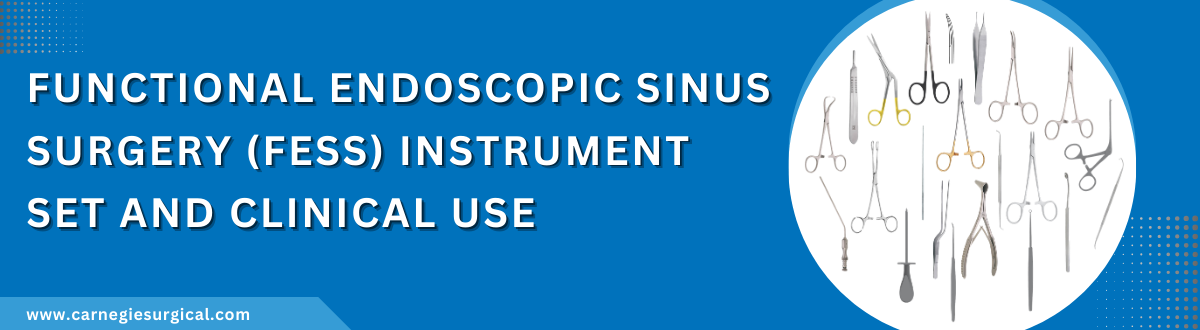
Functional Endoscopic Sinus Surgery (FESS) is one of the most important advancements in modern ENT and rhinology. Before it became widely adopted, traditional approaches were often performed using open or external techniques. These older techniques were effective in certain cases, but they frequently caused more tissue trauma, longer recovery time, and higher chances of scarring. FESS changed this by introducing a minimally invasive, endonasal approach that focuses on restoring natural sinus drainage while preserving healthy mucosa. At the heart of this technique is the Endoscopic Sinus Surgery instruments Set, a specialized collection of endoscopic sinus surgery tools designed for precision work inside the narrow anatomical spaces of the nasal cavity and paranasal sinuses.
What is an Endoscopic Sinus Surgery Instrument Set?
The Endoscopic Sinus Surgery Instrument Set is a standardized collection of tools used to perform the essential steps of endoscopic sinus surgery. Unlike general ENT surgical sets, FESS instruments are designed with long, slim shafts, delicate tips, and specialized angulations. These features allow surgeons to operate safely within the middle meatus, osteomeatal complex, and sinus cavities while working under rigid endoscopic visualization.
Most premium endoscopic sinus surgery instrument sets are manufactured using high-grade surgical stainless steel, often German-grade, to ensure long-term durability, corrosion resistance, and compatibility with repeated sterilization cycles. A complete basic set is usually designed to support the most common functional procedures, including uncinectomy, middle meatal antrostomy, anterior ethmoidectomy, and selective access to the posterior ethmoid and sphenoid sinus when needed. The “basic” term does not mean the set is simple; it means it contains the essential instruments required for routine FESS workflows.
Why You Need a Dedicated Endoscopic Sinus Surgery Set
Functional Endoscopic Sinus Surgery is performed in an area where critical structures are extremely close. The ethmoid sinuses sit between the orbit (eye) laterally and the skull base (brain) superiorly. The sphenoid sinus lies near the optic nerve and internal carotid artery. Because of this, sinus surgery requires instruments that allow controlled cutting, stable grip, and accurate tissue removal without tearing or excessive force.
A dedicated Sinus Surgery Instrument Set is important for three major reasons.
First
it supports mucosal preservation, which is the core principle of functional surgery. The goal is not to remove all sinus mucosa, but to restore ventilation and drainage while keeping healthy mucosa intact.
Second
these instruments provide precision in confined spaces, where normal straight instruments would be bulky and unsafe.
Third
a dedicated set improves surgical efficiency because standardized instruments support a consistent workflow.
Indications for Endoscopic Sinus Surgery
The Endoscopic Sinus Surgery Instrument Set is primarily used for patients with chronic sinonasal disease that does not improve with proper medical treatment. In clinical practice, the most common indication is chronic rhinosinusitis (CRS), either with nasal polyps (CRSwNP) or without nasal polyps (CRSsNP). These patients usually have persistent symptoms for more than 12 weeks and show endoscopic and CT evidence of disease. Surgery becomes necessary when medical therapy such as topical steroids, saline irrigations, and antibiotics (when indicated) fails to control symptoms.
Another common indication is recurrent acute rhinosinusitis (RARS), where patients experience multiple acute sinus infections per year due to underlying obstruction in the osteomeatal complex. Functional Endoscopic Sinus Surgery is also widely used for conditions like antrochoanal polyps, maxillary ostium stenosis, frontal recess obstruction, allergic fungal rhinosinusitis, and sinus mucoceles. In addition, the same instruments support diagnostic and therapeutic procedures such as biopsy of suspicious lesions, endoscopic removal of benign masses, and selected revision sinus surgeries where scar tissue and altered anatomy require careful dissection.
Who Invented Functional Endoscopic Sinus Surgery?
The functional philosophy behind FESS was pioneered by Professor Walter Messerklinger in Graz, Austria. Messerklinger’s research in the 1960s and 1970s showed that chronic sinus disease often begins in the anterior ethmoid region, especially around the osteomeatal complex. He also demonstrated that mucociliary clearance naturally travels toward the natural sinus ostia. This meant that surgery should focus on restoring the natural pathways instead of creating new drainage openings.
Messerklinger’s student and collaborator, Professor Heinz Stammberger, refined the surgical techniques, standardized the endoscopic approach, and helped spread the method worldwide through teaching and publications. In the United States, Professor David W. Kennedy played a major role in introducing the technique and popularizing the term “Functional Endoscopic Sinus Surgery” during the mid-1980s. Another key contributor was Harold Hopkins, whose rod-lens endoscope system made high-quality visualization possible, which is essential for safe endoscopic surgery.
Endoscopic Sinus Surgery Instruments List
A typical Endoscopic Sinus Surgery Instrument Set contains between 15 and 35 instruments depending on manufacturer and surgeon preference. Even though the exact contents can vary, most standard sets include the same functional categories. The instruments are chosen to allow step-by-step dissection, starting from the middle meatus and progressing deeper into the sinus system.
| Category | Common Instruments Included | Primary Clinical Use in FESS |
|---|---|---|
| 1) Rigid Endoscopes | 0° endoscope, 30° endoscope, 45° or 70° endoscope | Visualization of nasal cavity and sinuses. 0° for direct view, 30° for routine work, 45°/70° for frontal recess, sphenoid, and around-corner anatomy. |
| 2) Suction Instruments | Frazier suction tips (7–11 Fr), Suction elevators | Clears blood/secretions for safety and visibility. Suction elevators allow suction + blunt dissection during delicate work. |
| 3) Elevators and Dissectors | Freer elevator, Cottle elevator | Mucosal elevation and tissue plane development, especially during uncinectomy and ethmoid dissection. |
| 4) Cutting and Incision Instruments | Sickle knife, Endoscopic scissors (straight/angled) | Precise cutting of mucosa and soft tissue, including incision of the uncinate process and controlled trimming. |
| 5) Forceps (Through-Cutting) | Straight Blakesley, 45° upturned Blakesley, 90° upturned Blakesley, 120°/backbiting variations | Controlled removal of tissue and bony partitions (ethmoid work). Through-cutting helps reduce tearing and supports mucosal preservation. |
| 6) Backbiting Forceps and Punches | Backbiting forceps (antrum punch), Hajek-Kofler punch, Kerrison rongeurs (1–4 mm) | Enlargement of sinus ostia (especially maxillary). Used for controlled bony removal and antrostomy expansion. |
| 7) Curettes and Probes | Angled curettes, Coakley curettes, Ball probe / ostium seeker | Gentle tissue removal and anatomical identification. Ball probe helps locate natural ostium and prevents false opening creation. |
| 8) Packing and Dressing Instruments | Bayonet forceps, Dressing forceps | Placement/removal of packing, spacers, and hemostatic agents at the end of surgery and postoperatively. |
How Endoscopic Sinus Surgery Instruments Are Used (Step-by-Step)
Endoscopic Sinus Surgery is usually performed in a stepwise sequence. The set is designed to support this workflow in an organized manner. The procedure begins with diagnostic endoscopy using the 0° scope and suction to identify key landmarks such as the middle turbinate, uncinate process, and middle meatus. Once the anatomy is confirmed, the surgeon performs an uncinectomy, which is often the first functional surgical step. A sickle knife is used to incise the uncinate process, followed by Freer elevator dissection and removal with straight Blakesley forceps.
After uncinectomy, the natural maxillary ostium is identified using a ball probe. This is an important step because creating an accessory opening can lead to recirculation and persistent symptoms. Once identified, the ostium is enlarged using backbiters or Kerrison punches to create a proper middle meatal antrostomy. A 30° endoscope is commonly used here because it provides better inferior and lateral visualization.
The next stage is often anterior ethmoidectomy, where the ethmoid bulla is opened and diseased partitions are removed. Angled Blakesley forceps, through-cutting forceps, suction elevators, and curettes are used to remove ethmoid septations while preserving mucosa. The surgeon proceeds carefully, keeping the dissection medial to the lamina papyracea and inferior to the skull base.
In cases where disease extends further, the surgeon may perform posterior ethmoidectomy and sphenoidotomy. These steps require angled scopes and instruments, such as 90° and 120° forceps, to safely reach posterior structures. At the end of the procedure, hemostasis is achieved using suction, topical agents, and sometimes suction cautery if available. The surgical field is irrigated, and absorbable packing or spacers may be placed using bayonet forceps to prevent adhesions and maintain middle meatal patency.
Safety in Endoscopic Sinus Surgery: Why Instrument Design Matters
The design of instruments directly supports complication prevention. The ethmoid cavity is surrounded by the orbit and skull base, so uncontrolled force or poor visualization can lead to serious complications such as orbital injury, CSF leak, or major bleeding. The lamina papyracea is extremely thin, and lateral pressure with forceps can breach it. Similarly, aggressive superior curettage can injure the skull base, causing CSF leak.
This is why through-cutting forceps, delicate curettes, and angled endoscopes are so important. They allow the surgeon to remove tissue in small, controlled bites rather than tearing large sections. In the sphenoid region, awareness of the optic nerve and carotid artery is essential, and careful ostium identification with probes prevents dangerous misdirection.
Sterilization and Maintenance of Instruments
Instruments must be sterilized properly to maintain safety and long-term durability. Most metal instruments are steam-autoclaved, while endoscopes and light cables require careful handling and may use low-temperature sterilization depending on institutional protocols. Instruments with lumens, such as suction tubes, require thorough cleaning before sterilization to prevent blockage and contamination.
Standardization of the Sinus Surgery instruments set in a hospital offers major workflow advantages. OR teams become familiar with the tray layout, reducing setup time. Surgeons operate faster when instruments are predictable. Training also becomes easier for residents and scrub nurses. From a procurement perspective, standardized sets simplify inventory control, replacement planning, and quality assurance.
Conclusion
The Endoscopic Sinus Surgery instruments set is not just a collection of tools, it is the foundation of functional sinus surgery. It represents decades of anatomical research, surgical refinement, and instrument engineering aimed at achieving one goal: restoring natural sinus ventilation and drainage while preserving mucosal health. For ENT surgeons, mastery of this basic set is essential for safe and efficient FESS. For hospitals and surgical centers, investing in a complete, standardized set directly improves operative workflow, patient safety, and long-term outcomes. Even as powered instruments, navigation systems, and advanced frontal tools continue to evolve, the basic FESS set remains the core platform upon which modern rhinologic surgery is built.
References
-
Wikipedia Contributors. Functional endoscopic sinus surgery (FESS).
https://en.wikipedia.org/wiki/Functional_endoscopic_sinus_surgery -
ENT & Audiology News. Heinz Stammberger: the father of functional endoscopic sinus surgery.
https://www.entandaudiologynews.com/features/ent-features/post/heinz-stammberger-the-father-of-functional-endoscopic-sinus-surgery -
Kennedy DW, Zinreich SJ, Rosenbaum AE, Johns ME. Functional endoscopic sinus surgery: Theory and diagnostic evaluation. Arch Otolaryngol Head Neck Surg. 1985.
https://pubmed.ncbi.nlm.nih.gov/4038607/ -
Stammberger H. Endoscopic endonasal surgery—concepts in treatment of recurring rhinosinusitis. Otolaryngol Head Neck Surg. 1986.
https://pubmed.ncbi.nlm.nih.gov/3086432/ -
Stammberger H, Posawetz W. Functional endoscopic sinus surgery: Concept, indications and results of the Messerklinger technique. Eur Arch Otorhinolaryngol. 1990.
https://pubmed.ncbi.nlm.nih.gov/2361292/ -
Fokkens WJ, Lund VJ, Hopkins C, et al. EPOS 2020: European Position Paper on Rhinosinusitis and Nasal Polyps. Rhinology Suppl. 2020.
https://www.rhinologyjournal.com/Documents/Supplements/supplement_29.pdf -
Orlandi RR, Kingdom TT, Smith TL, et al. International Consensus Statement on Allergy and Rhinology: Rhinosinusitis 2021 (ICAR-RS). Int Forum Allergy Rhinol. 2021.
https://pubmed.ncbi.nlm.nih.gov/33576195/ -
Zinreich SJ, Kennedy DW, Rosenbaum AE, et al. Paranasal sinuses: CT imaging requirements for endoscopic surgery. Radiology. 1987.
https://pubmed.ncbi.nlm.nih.gov/3575714/
Disclaimer: This article is provided as a general informational service and does not constitute any legal or medical advice.

